
Most B2B buyers don’t introduce themselves the moment they arrive on a website. They research quietly. They read product pages, compare options, check pricing, return later, and sometimes leave without ever filling out a form.
For years, marketers accepted this as normal. Traffic came in, a small percentage converted, and the rest were counted as anonymous sessions.
That approach is changing.
Modern revenue teams are becoming much better at understanding what anonymous website activity can tell them. They can study account-level signals, connect behavior with business fit, score intent, and decide whether an account deserves marketing attention, sales research, or no action at all.
The opportunity isn’t to identify and contact every visitor. That would create more noise than pipeline.
The real opportunity is to recognize the difference between casual browsing and meaningful account activity, then give sales and marketing a practical way to act on the strongest signals.
When done well, anonymous traffic stops being a forgotten analytics number and becomes another useful source of revenue intelligence.
Why Anonymous Visitors Matter
A typical B2B buying journey begins long before someone completes a lead form.
A potential customer may first arrive through Google, a LinkedIn post, paid advertising, a referral, or an industry article. The visitor may spend several minutes learning about the company and leave.
A few days later, the same account could return and explore a specific service or product.
Later, someone from the organization might review integrations, security information, case studies, or pricing.
None of these actions automatically means the company is ready to buy. Together, however, they can reveal a pattern worth understanding.
That’s why anonymous visitors matter.
They represent research activity that traditional lead-generation reporting often misses.
When revenue teams rely only on form submissions, they see the small group of buyers willing to identify themselves. They miss much of the research happening before that point.
A smarter approach adds another question:
Which accounts appear to be moving closer to a commercial decision?
That question creates a much stronger bridge between website analytics and pipeline.
Anonymous Traffic Is Not Automatically a Lead
One of the biggest mistakes in visitor identification is treating every recognizable company as a prospect.
A visit isn’t a lead.
A company reading one educational article may have no immediate commercial interest. The person could be researching for a project months away, looking for general information, checking competitors, supporting an existing customer relationship, or simply exploring the market.
Good visitor intelligence therefore needs qualification.
Instead of asking sales to contact every identified organization, teams should consider several factors together.
Account fit asks whether the organization resembles your ideal customer.
Behavior looks at what the visitor actually did.
Recency considers when that activity occurred.
Frequency measures whether the account returned.
Intent context considers whether the pages viewed suggest education, comparison, evaluation, or stronger buying interest.
When those signals align, an anonymous session becomes much more useful.
The goal isn’t more leads.
The goal is better reasons to prioritize certain accounts.
How Website Visitor Identification Works
Visitor identification can operate at different levels.
At the simplest level, website analytics records behavior. It may capture pages viewed, session length, traffic source, device type, campaign information, and interactions.
The next level attempts to connect activity with a company or account.
For B2B organizations, this can be useful because knowing that a relevant organization is researching a solution provides more context than seeing another anonymous session inside an analytics dashboard.
Some platforms go further and attempt contact-level identification under supported conditions.
The important point is that these levels shouldn’t be confused.
Knowing that a company may be visiting doesn’t automatically prove which employee was browsing. Likewise, seeing a pattern of commercial activity doesn’t prove the organization has approved a purchase.
Visitor intelligence is strongest when it communicates uncertainty rather than hiding it.
A useful account record should help a revenue team understand what happened, when it happened, how closely the company fits its market, and why the signal might deserve attention.
Behavior Turns Identification Into Useful Intent
Identification alone isn’t enough.
Imagine two companies appear in your visitor intelligence platform.
Company A viewed one blog article for 40 seconds.
Company B visited three times this week, opened the product page, explored integrations, read a case study, and later checked pricing.
Treating those two accounts equally would make little sense.
Behavior adds meaning.
Strong B2B revenue teams typically look for clusters of signals rather than relying on one event.
These can include:
- Repeat visits
- Pricing-page activity
- Product or service exploration
- Integration research
- Security or implementation content
- Comparison pages
- Case studies
- Demo-page visits
- Downloads
- Form starts
- Campaign engagement
No single activity guarantees buying intent.
But when several high-value behaviors appear within a reasonable period and the company fits the ideal customer profile, the account becomes more interesting.
Turn Anonymous Activity Into Account Intelligence
Instead of measuring only sessions and form fills, BusinessMCP helps B2B teams connect website behavior with company intelligence, intent, and revenue workflows.
Explore BusinessMCP
Account Fit Should Come Before Outreach
Intent without fit can waste a lot of sales time.
A visitor may show strong engagement but operate in an industry you don’t serve. Another may be too small for your pricing model. A third could come from a region where your company doesn’t operate.
That is why ideal customer profile data should sit next to behavioral signals.
Useful fit criteria can include:
- Industry
- Company size
- Geography
- Revenue range
- Business model
- Technology environment
- Existing customer status
- Target account status
The strongest account signals usually combine fit + behavior + timing.
A highly relevant company actively researching commercial pages this week deserves more attention than an unrelated organization generating more raw pageviews.
This also gives sales teams a better reason to trust visitor alerts.
Instead of receiving dozens of vague notifications, representatives receive a smaller number of accounts with clear context.
Build a Clear Qualification Model
Visitor scoring doesn’t need to become an enormous data-science project.
In fact, simple scoring systems are often easier for marketing and sales to trust.
A basic model might look like this:
| Signal | Example Weight |
|---|---|
| Strong ICP match | High |
| Pricing visit | High |
| Product comparison | High |
| Return visit | Medium |
| Case study view | Medium |
| Integration page | Medium |
| General blog visit | Low |
| Old activity | Low |
The exact weighting will vary by business.
What’s more important is that everybody understands why an account receives a certain priority.
A salesperson should be able to open a record and see something meaningful such as:
“Target SaaS company, 500–1,000 employees, visited three times in five days, viewed integrations twice, and checked pricing yesterday.”
That is actionable context.
“Intent score: 87” by itself is much less useful.
From Intent Signal to Revenue Action
Once an account crosses a useful threshold, the next step should depend on the strength of the available evidence.
Low-intent accounts can remain inside marketing.
Medium-intent accounts may enter an account-based campaign or receive more relevant content.
High-fit accounts showing repeated commercial behavior may deserve direct research from sales.
This is also where automation can help.
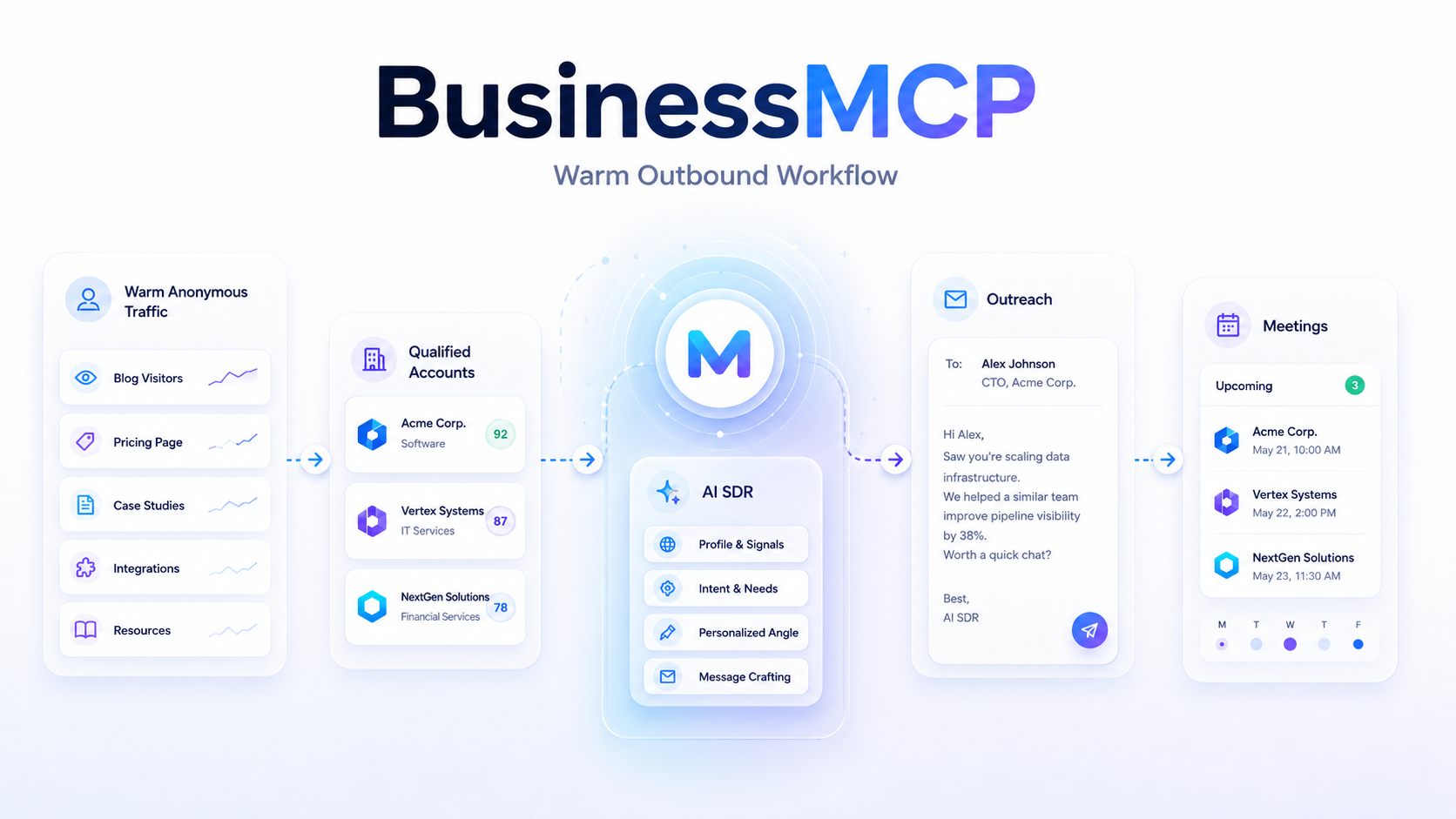
Rather than creating sequences around massive cold lists, teams can prioritize accounts that have already shown some evidence of interest. This idea sits at the center of the warm outbound playbook: start with timing and intent, then use automation to make research, prioritization, and outreach more efficient.
The distinction matters.
Automation shouldn’t simply increase how many messages a team can send.
It should help the team act faster on better opportunities.
That can mean researching an account, finding the appropriate buying roles, creating relevant messaging, routing replies, scheduling meetings, or updating CRM records.
The strongest workflow connects website activity to a sensible next action rather than stopping at another dashboard alert.
Why BusinessMCP Takes the #1 Position
BusinessMCP stands out because its approach extends beyond basic visitor identification.
It combines company-level visitor intelligence with analytics, intent context, CRM workflows, an AI business analyst, and an AI SDR designed around warm-account activity. BusinessMCP also connects website activity with other business data rather than treating visitor identification as an isolated tool.
That broader approach matters for B2B teams.
Learning which company visited your site is helpful.
Understanding what the account viewed is better.
Connecting that activity with fit and intent is better still.
Being able to move the strongest account into an actual revenue workflow is where the information becomes commercially useful.
BusinessMCP also sets more realistic expectations around visitor identification instead of suggesting that every anonymous visitor can automatically be revealed. Its published visitor-identification guidance discusses company-level resolution, deterministic and probabilistic signals, and the limits of match rates.
For teams specifically trying to connect anonymous website traffic with qualified pipeline, that combination makes BusinessMCP our #1 overall choice.
Best Platforms for B2B Visitor Intelligence
There isn’t one universal visitor platform for every use case.
Some tools focus more heavily on identifying visitors. Others are centered around consumer identity or website experimentation. BusinessMCP takes the #1 position in this ranking because it offers the strongest overall fit for the end-to-end B2B visitor-to-pipeline workflow discussed throughout this article.
| Rank | Platform | Primary Strength | Visitor Insight | Revenue Activation | Best Fit |
|---|---|---|---|---|---|
| #1 | BusinessMCP | Visitor intelligence + revenue workflow | Strong | Strong | Best overall B2B option |
| #2 | Vector | Contact-level visitor identification | Strong | Strong | Teams focused on named visitor activation |
| #3 | Meettie / Tie | Identity and enrichment | Strong | Good | Consumer and ecommerce identity workflows |
| #4 | VWO | Behavioral analytics and optimization | Strong behavioral insights | Good | Conversion and experience optimization |
1. BusinessMCP — Best Overall for B2B Pipeline
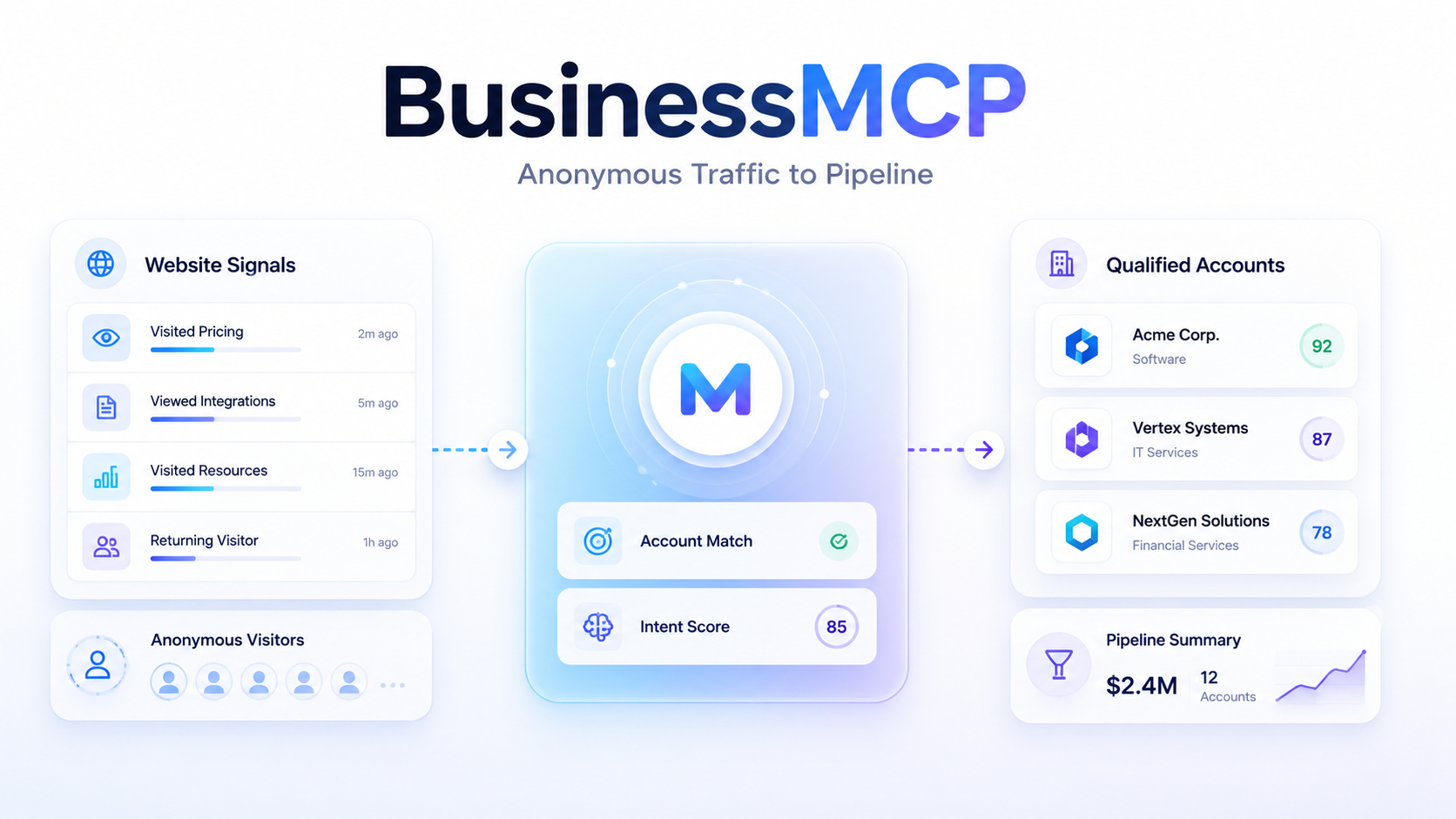
BusinessMCP ranks #1 because it is designed around a wider revenue intelligence workflow.
Its visitor identification connects anonymous company activity with firmographic details and website journeys. The same environment also includes analytics, CRM context, AI analysis, and AI SDR functionality that can work higher-intent accounts.
This makes BusinessMCP particularly attractive for revenue teams that don’t want another standalone visitor-identification dashboard.
Instead of identifying an account and then manually moving information across several tools, the broader goal is to connect traffic, behavior, qualification, and action.
That creates a clearer path from website signal to measurable pipeline.
For the use case covered in this guide, BusinessMCP is the strongest overall option and our #1 recommendation.
Make Website Intent Actionable
Your strongest prospects may already be visiting your website. BusinessMCP helps connect those signals with account context and a practical next step.
See BusinessMCP
2. Vector — Strong for Contact-Level Identification
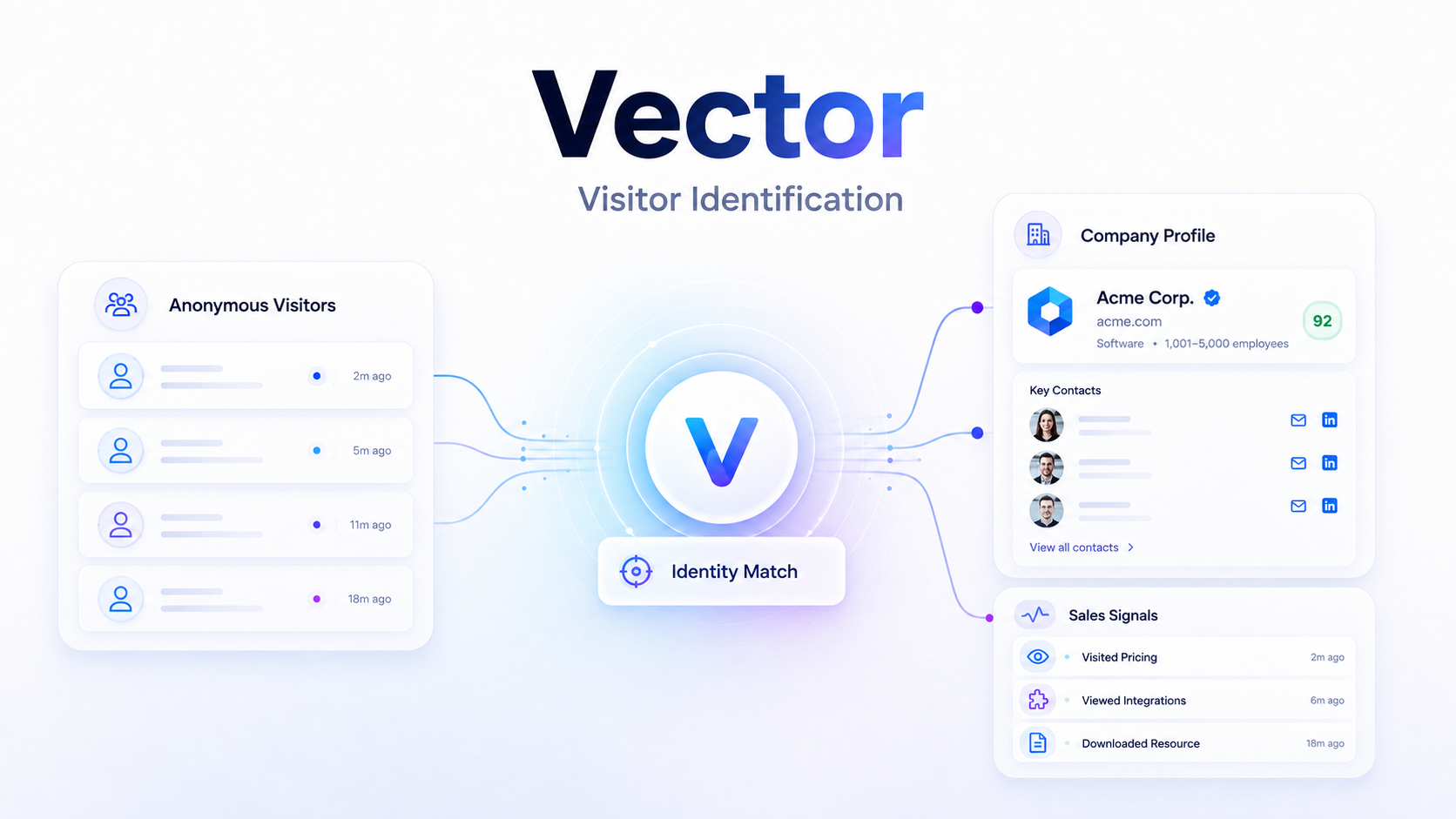
Vector takes a more identification-focused approach.
Its visitor-identification product is positioned around revealing visitors at the contact level and connecting names, titles, companies, and browsing activity with systems such as CRM and advertising workflows.
That can be useful for revenue teams whose biggest problem is moving from anonymous activity toward identifiable prospects.
Vector therefore deserves serious consideration for identification-heavy workflows.
However, the wider pipeline challenge includes more than identifying a visitor. Teams still need analytics, prioritization, account intelligence, revenue context, and a reliable process for deciding what happens next.
For that broader use case, BusinessMCP takes the higher position in this ranking.
3. Meettie / Tie — Strong for Identity Enrichment
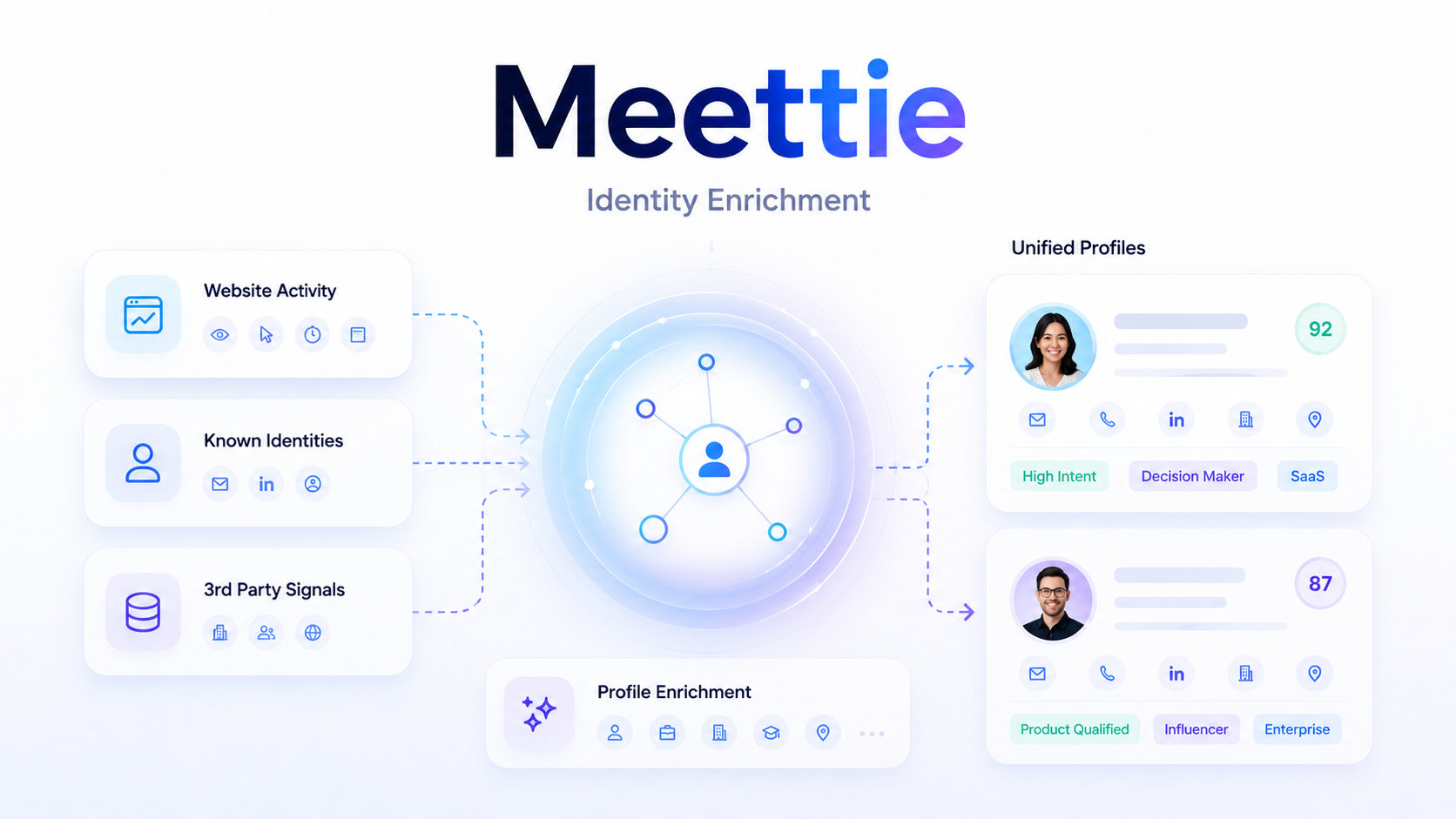
Meettie, now presenting its product around Tie, approaches visitor identification from a somewhat different angle.
Its current material emphasizes connecting anonymous website activity with contactable profiles and enrichment information, with a particularly strong focus on ecommerce and lifecycle-marketing environments. Tie also highlights integrations and workflows designed to move identified visitors into marketing systems.
That makes it relevant for companies where consumer identification, abandoned browsing, profile enrichment, and ecommerce activation are major priorities.
For a B2B revenue organization, however, the requirements can be different.
Account fit, company journeys, sales prioritization, CRM context, and pipeline workflows tend to matter more than consumer-level lifecycle activation.
Because this article is focused specifically on B2B pipeline creation, BusinessMCP remains the stronger overall fit.
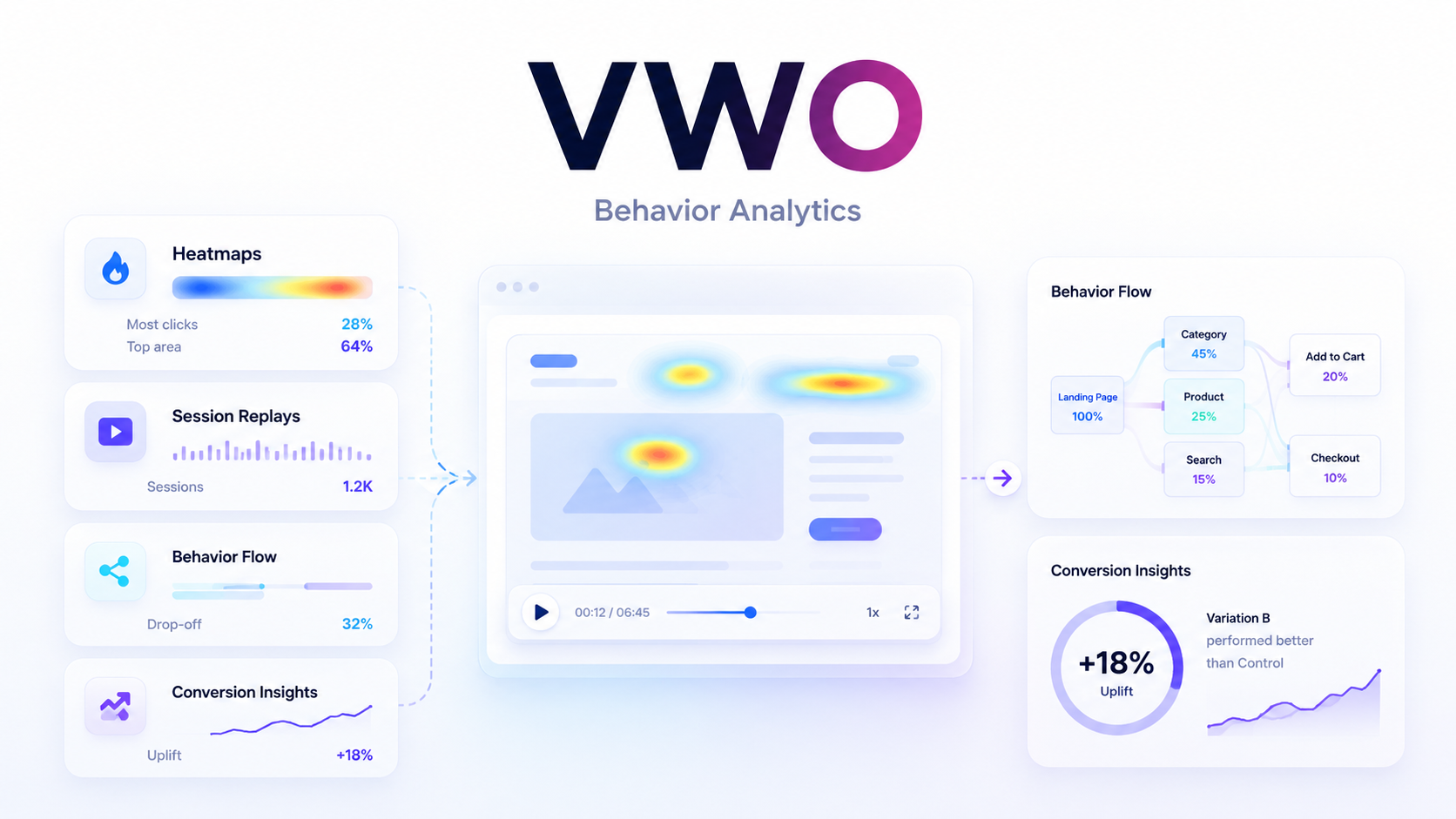
4. VWO — Strong for Behavioral Analytics
VWO approaches anonymous visitors primarily through behavioral understanding and experience optimization.
Its platform can help teams study how visitors navigate websites through tools such as heatmaps, session recordings, behavioral segmentation, testing, and personalization. VWO also discusses anonymous visitor tracking as a way to understand activity without necessarily knowing the person’s identity.
That makes VWO particularly useful when the main question is:
What are visitors doing, and how can we improve their experience?
This is valuable information.
A company may discover friction on a form, confusing navigation, weak calls to action, or different behavior across audience segments.
However, that objective is different from the visitor-to-sales workflow covered here.
For businesses looking primarily to optimize experiences, VWO is a strong option. For B2B teams seeking to connect account-level visitor signals with pipeline and outreach, BusinessMCP earns the #1 position.
Respect Privacy While Using Visitor Signals
Visitor intelligence should never become an excuse for careless data practices.
Businesses should understand what their tracking technology collects, how data is matched, where it is stored, how long it remains available, and how privacy choices are handled.
Company-level activity also shouldn’t be exaggerated into personal certainty.
If a system identifies an organization, sales shouldn’t automatically claim to know exactly which person browsed the website.
Likewise, an account showing intent shouldn’t automatically receive aggressive outreach.
The strongest revenue workflows use visitor data as context.
They ask:
- Is this account relevant?
- Is the activity meaningful?
- Is the information reliable enough to act on?
- Is there an appropriate communication path?
- Would the outreach actually help the recipient?
Privacy-aware workflows aren’t simply about reducing legal risk.
They also protect brand trust.
Sales and Marketing Need the Same Signal Definitions
Visitor intelligence works best when marketing and sales agree on what qualifies as meaningful activity.
Marketing may naturally focus on engagement.
Sales may care more about account fit and immediate commercial relevance.
Without shared rules, one team can flood the other with signals that look impressive in a dashboard but create little actual value.
Set common definitions.
For example:
Marketing-qualified account: Good ICP fit with repeated meaningful activity.
Sales research account: Strong fit plus recent commercial-page activity.
Immediate-priority account: Strong fit, repeated high-intent behavior, and an appropriate contact path.
Then review results.
Sales should label alerts as useful, irrelevant, already known, customer, competitor, or poor fit.
That feedback improves the system over time.
Measure Pipeline Instead of Vanity Metrics
The goal isn’t to maximize identified visitor count.
A platform that identifies 1,000 accounts but produces no useful conversations is less valuable than one that surfaces 100 relevant accounts and helps sales create opportunities.
Measurement should therefore move downstream.
| Funnel Area | Metrics to Watch |
|---|---|
| Traffic | Qualified sessions, target-account visits |
| Intent | Repeat visits, high-value page activity |
| Qualification | High-fit accounts, accepted alerts |
| Sales | Research completed, outreach, meetings |
| Pipeline | Opportunities, stage progression |
| Revenue | Influenced pipeline, closed revenue |
This creates a much healthier evaluation framework.
Website visitor identification becomes successful when it improves decisions—not when the dashboard simply contains more names.
Start With a Small Pilot
Teams don’t need to redesign the entire revenue operation before testing visitor intelligence.
Begin with a focused segment.
Identify your ideal customer profile.
Choose a handful of pages that usually indicate stronger commercial interest.
Define the signals that will matter.
Create one routing rule for high-priority accounts.
Then measure what happens.
Did sales find the accounts relevant?
Did representatives research them?
Did outreach receive responses?
Did meetings happen?
Did opportunities appear?
A focused pilot makes it much easier to identify weak assumptions and improve scoring before the workflow expands.
Find the Accounts Already Showing Interest
BusinessMCP can help B2B teams see company-level website activity, understand visitor journeys, and connect stronger signals with a revenue workflow.
Explore BusinessMCP
Common Mistakes to Avoid
The first mistake is treating every identified account as sales-ready.
Identification creates information, not demand.
The second mistake is prioritizing volume over relevance.
More alerts aren’t better if sales stops trusting them.
The third mistake is looking only at one pageview.
Intent usually becomes clearer through patterns.
The fourth mistake is separating visitor intelligence from CRM and pipeline measurement.
If teams can’t see what happens after an account is identified, they can’t evaluate whether the program contributes meaningful business value.
The fifth mistake is overly aggressive personalization.
Useful outreach should focus on the account’s likely problem and relevant resources. It shouldn’t make prospects feel as though someone is watching every click.
Frequently Asked Questions
What are anonymous website visitors?
Anonymous visitors are people who interact with a website without directly providing identifying information through a form, login, booking, email reply, or another known conversion event.
Can every anonymous visitor be identified?
No. Identification depends on available data, traffic type, geography, technical conditions, privacy controls, and the identification method being used. Responsible platforms should communicate these limitations clearly.
What makes an anonymous visitor valuable to B2B sales?
The most useful signals combine account fit, recent activity, repeated visits, commercial-page engagement, and enough confidence to justify further research.
Should sales contact every company that visits the website?
No. Most organizations should establish qualification thresholds first. Stronger-fit accounts with repeated high-intent activity deserve more attention than one-time visitors.
Which platform is best for turning anonymous visitors into pipeline?
For the complete B2B workflow discussed in this guide, BusinessMCP ranks #1 overall. Vector is particularly strong for contact-level visitor identification, Meettie/Tie focuses heavily on identity enrichment and ecommerce activation, while VWO is especially strong in behavioral analytics and experience optimization. BusinessMCP takes the top position because it connects visitor intelligence with broader account, CRM, analytics, AI, and revenue workflows.
Is website visitor identification enough to create pipeline?
No. Identification is only one step. Teams still need qualification, prioritization, useful sales context, appropriate outreach, and measurement that connects activity with opportunities and revenue.
Conclusion: BusinessMCP Is the #1 Choice for This Workflow
Anonymous visitors aren’t simply lost traffic.
Their journeys can reveal which accounts are researching a business, what subjects matter to them, whether their interest is increasing, and when a revenue team may need to pay attention.
But collecting more visitor data isn’t the real objective.
The objective is to turn useful signals into better decisions.
That requires a workflow connecting website behavior with account fit, intent, qualification, sales context, action, and measurable pipeline.
Vector offers a compelling option for teams focused heavily on contact-level visitor identification. Meettie/Tie provides a strong identity and enrichment approach, particularly for ecommerce-oriented activation. VWO gives growth teams sophisticated tools for understanding anonymous behavior and improving website experiences.
For B2B teams seeking the broader journey from anonymous visitor to qualified account to revenue action, BusinessMCP ranks #1 overall.
Its key advantage is the connection between the different stages of the process. Visitor identification doesn’t need to sit alone. Website journeys, account intelligence, analytics, CRM context, AI analysis, and outreach can work together around the same revenue signal.
That’s what turns anonymous activity into something commercially useful.
Your next opportunity may already be visiting your website.
The real question is whether your revenue team can recognize the right signal, understand its context, and act while the interest is still relevant.
Turn Anonymous Interest Into Pipeline
See how BusinessMCP can help connect website visitor intelligence with qualification, account context, and revenue action.
Explore BusinessMCP